

A child’s chronological age is easy to establish, but developmental abilities do not always follow the same timetable. A six-year-old may demonstrate age-appropriate communication while requiring additional assistance with dressing or early academic tasks. Understanding the difference between chronological age and developmental age helps families interpret assessment reports and make informed decisions about support.
What is chronological age?
Chronological age is the time elapsed since a person’s birth, usually expressed in years and months. Professionals use chronological age when selecting many standardized assessments and determining the appropriate age-based reference group. It also provides context for educational placement and developmental expectations.
For infants born prematurely, clinicians may use corrected age for certain developmental purposes during early childhood. Whether an adjustment is appropriate depends on the child’s age, clinical circumstances and assessment guidelines.
What does developmental age mean?
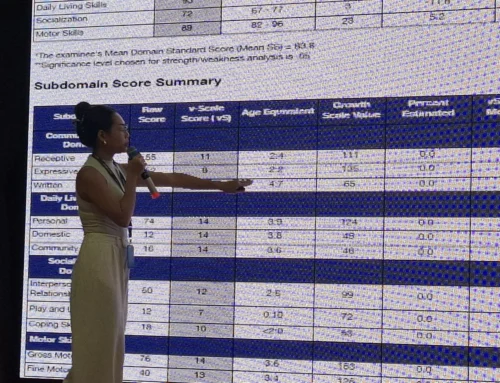
Developmental age is a descriptive term sometimes used to communicate how particular abilities compare with skills typically demonstrated at different ages. Some standardized assessments provide age-equivalent scores for specific domains or tasks. These scores are derived from the performance of reference groups according to the instrument’s scoring procedures.
A child may demonstrate different developmental levels in communication, motor abilities, social participation and daily living skills. Assigning one developmental age to the entire child can conceal these differences and create misleading expectations about what the child understands or can accomplish.
Understanding age-equivalent scores
An age-equivalent score of four years on a particular assessment does not mean that an older child functions like a four-year-old in every respect. It generally means that the obtained raw score corresponds to a reference value associated with that age on the specific measure.
Age-equivalent scores have important statistical limitations. The intervals between them are not necessarily equal, and they should not be treated as precise measurements of developmental delay. Subtracting an age-equivalent score from chronological age does not reliably quantify how many years of development a child has lost.
How should families interpret developmental differences?
Review the specific skills assessed, the child’s performance and the limitations described in the report. Standard scores, percentile ranks and confidence intervals may provide more useful information about relative performance when the assessment supports their interpretation.
Functional observations are equally important for planning support. A child may demonstrate a skill during structured testing but need assistance applying it in a busy classroom. Language exposure, educational opportunities and assessment conditions can also influence results, particularly for multilingual children in Cambodia.
Use assessment findings to establish appropriate goals
Intervention should address the child’s current abilities while respecting their chronological age, preferences and dignity. An older student who needs support with foundational reading skills should have access to suitable, age-respectful learning materials rather than automatically receiving activities designed for much younger children.
Set specific goals for communication, academic learning or daily living as appropriate. Monitor progress through meaningful activities and independent performance. A child may acquire important new skills even when age-based standardized scores remain relatively stable.
Developmental assessment in Phnom Penh
OrbRom Center provides developmental and educational assessment options, alongside individual special education intervention, speech and language therapy and occupational therapy.
Families can bring previous reports and examples of everyday functioning to discuss the meaning of developmental findings. Ask whether reported age equivalents are appropriate for the instrument and how they relate to practical recommendations. A useful assessment identifies strengths, support needs and realistic next steps without reducing a child’s identity or abilities to a single developmental age. Decisions about intervention and school participation should reflect the complete assessment profile and the child’s individual circumstances.


Leave A Comment