
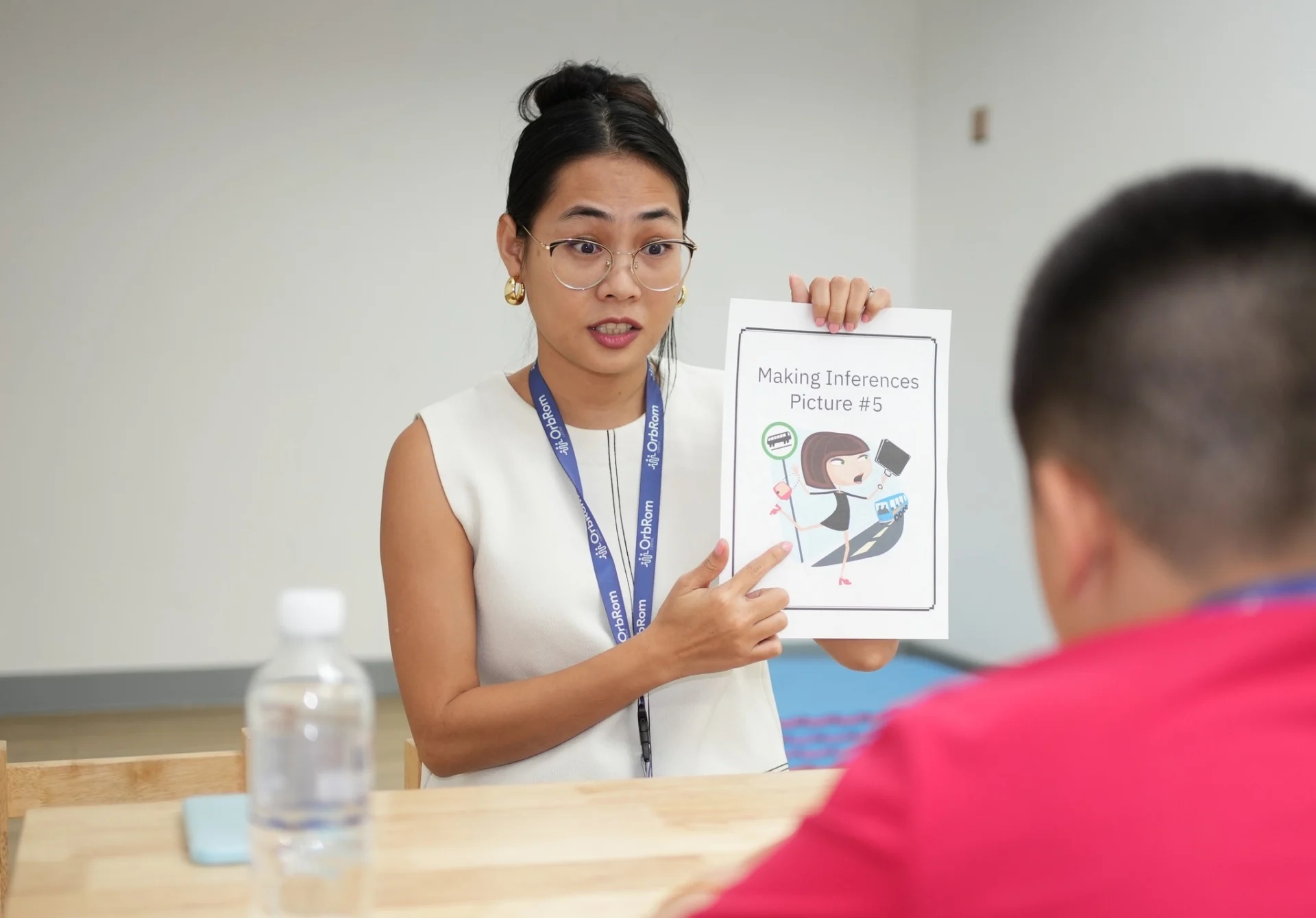
Families often tell us the same thing: their child can read the words or repeat the facts, but still struggles to understand what a teacher really means, follow the “hidden rules” of a classroom, or explain what happened in a story. That gap is frequently an inference problem — and it can affect learning, friendships, and behavior.
At OrbRom Center, special education Phnom Penh support is designed to build these thinking skills step by step, using structured teaching, visuals, and clear routines so learners can succeed across settings.
What “making inferences” really means in special education
Inferences are the conclusions we draw when information is not directly stated. A student uses clues (pictures, context, tone of voice, cause-and-effect) to figure out what is likely happening, what someone might feel, or what will happen next.
In special education Phnom Penh classrooms, inference challenges often show up as:
-
Misunderstanding teacher directions unless they are very literal
-
Difficulty answering “why” and “how” questions
-
Trouble reading social situations (e.g., jokes, frustration, sarcasm)
-
Guessing instead of using evidence
-
Getting stuck when a task changes slightly
How SPED teachers teach inferences effectively
A strong SPED approach does not rely on “just think harder.” It uses explicit instruction and repetition until the child can generalize the skill.
Common evidence-based steps include:
-
Teach the rule: “Inference = clues + what I know.”
-
Use consistent question prompts: “What do you see? What do you know? What could be happening?”
-
Model the thinking out loud (teacher demonstrates, student repeats, then student leads).
-
Gradually increase difficulty: from simple pictures → short scenarios → classroom routines → peer situations.
-
Track progress with a clear rubric (accuracy, reasoning, independence, and generalization).
If your child struggles to understand social cues, this article may help: Difficulty Understanding Social Cues
Why inference skills matter for behavior and independence
When a child cannot infer meaning, they often feel confused or unsafe. That can look like refusing work, melting down, or “not listening.” In special education Phnom Penh settings, improving inference skills can reduce frustration because the child starts to predict routines, understand expectations, and explain their thinking.
This also connects to emotional understanding and self-regulation. A helpful related read is: Understanding Emotions
When to consider a full learning profile
If inference difficulty is persistent, it may be linked to language processing, attention, autism-related social communication, or learning differences. A targeted assessment can clarify the root cause and guide a practical plan for home and school.
OrbRom Center provides formal evaluations through our Assessments service, which helps families and schools build the right support plan. With the right data, special education Phnom Penh intervention becomes more precise — and progress becomes easier to measure.
Special education support works best when inference skills are taught explicitly, practiced consistently, and reinforced across real classroom situations.
We are the only Preschool specialized on children with special needs in PhnomPenh.
- Internationally qualified teachers
- Cambodia’s largest sensory room
- Outdoor swimming pool
- Covered outdoor playground
📞 Phone: 077.455.993
Telegram Link: https://t.me/OrbRom


Leave A Comment