
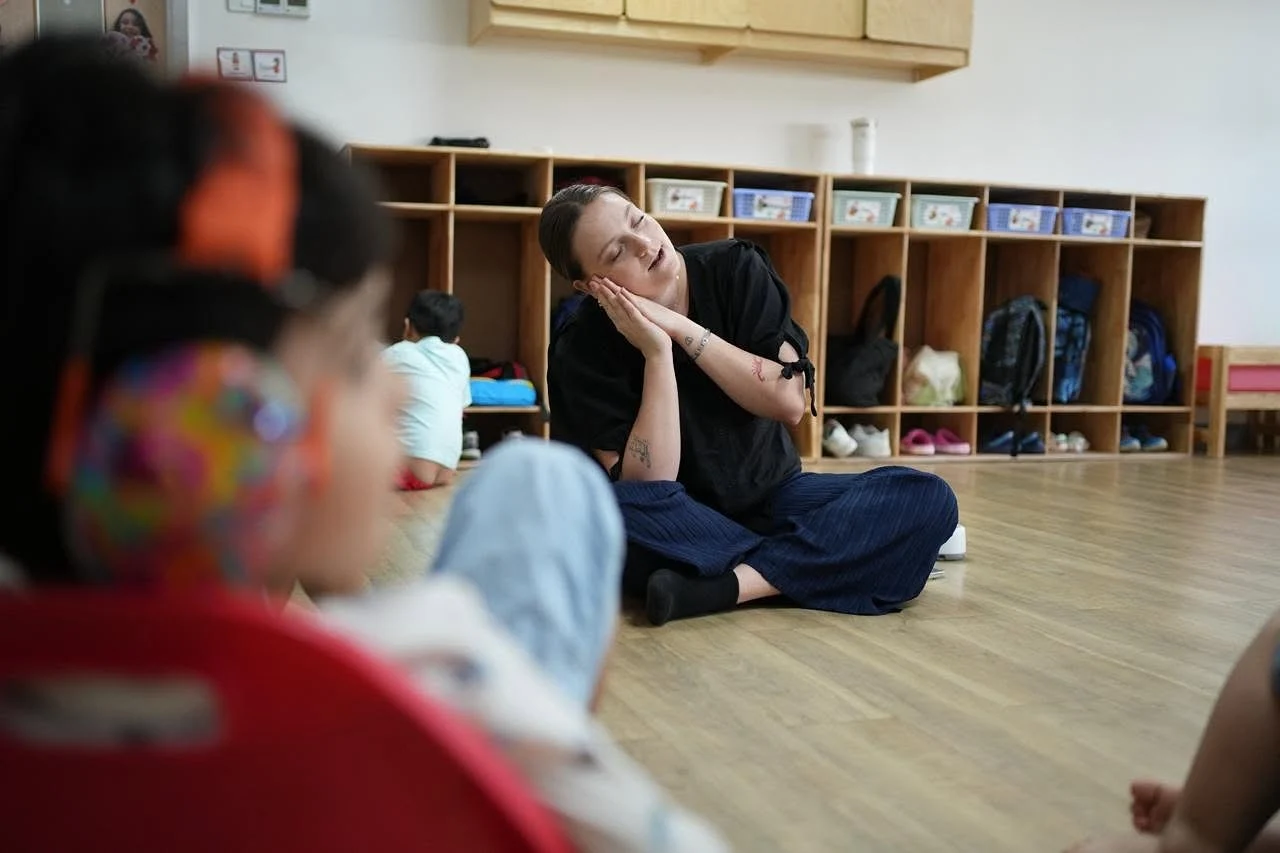
Movement and gesture activities in preschool can help children understand language, practise shared attention, and participate in classroom routines. Simple actions paired with spoken words give children more than one way to understand an instruction. For children who are developing communication or finding group activities challenging, predictable movement games can provide accessible opportunities to join in. At OrbRom Center in Phnom Penh, learning activities can be adapted to each child’s strengths, needs, and developmental readiness.
How gestures support language development
Children learn through listening, watching, moving, and interacting with others. A familiar gesture, such as placing hands beside the face to represent sleeping, gives a visible meaning to a spoken word. Adults can pair one short phrase with one clear action and pause for a response. Children may imitate the action, point, vocalize, or communicate in another way. These responses help educators understand how a child processes language and participates. Gestures can complement speech rather than replace opportunities for spoken communication.
Developing attention through group routines
A predictable group routine helps children anticipate what comes next. An educator might begin with a greeting, introduce several simple actions, and finish with a familiar closing signal. Repeated opportunities allow children to practise listening, remembering instructions, and shifting attention between the adult and peers. Some children join immediately; others first observe and need additional processing time. Participation should be measured against individual goals rather than expecting every child to perform the same action at the same moment.
Encouraging social interaction and turn-taking
Group movement games can create natural opportunities to notice other children, take turns, and respond to shared cues. Children might choose an action for the group, wait for a signal, or practise starting and stopping together. Educators can model phrases such as ‘my turn’ and ‘your turn’ while accepting pointing, gestures, or visual choices. These activities are most useful when the demands remain manageable and each child has a meaningful way to participate.
Adapting activities for individual learning needs
Children differ in motor coordination, sensory preferences, attention, and language comprehension. One child may benefit from a visual schedule, while another needs fewer instructions or a quieter place in the group. Educators can slow the pace, simplify a movement, or offer a seated alternative. A child who is uncomfortable with noise or proximity may need a smaller group or additional space. The purpose is to support access and confidence without forcing imitation, eye contact, or physical interaction.
Connecting classroom activities with therapy goals
Preschool activities can reinforce skills addressed through individualized intervention. Speech therapy may focus on understanding instructions, expressing choices, and using functional communication. Occupational therapy may address body awareness, motor planning, or participation in classroom routines. Collaboration between educators and therapists can help children encounter consistent cues across different settings. A successful group activity is one observation; progress should be reviewed over time and across everyday situations.
Movement ideas for families
Families can try familiar action songs, animal movements, or simple pretend-play gestures at home. Start with one action, use a short instruction, and allow time for the child to respond. Offer choices, celebrate attempts, and adjust the task if the child becomes tired or overwhelmed. Short, enjoyable routines often provide more useful practice than long sessions that demand repeated performance.
Preschool learning at OrbRom Center
OrbRom Center provides early learning and individualized developmental support in Phnom Penh. Families can learn about the OrbRom preschool program, explore speech therapy, and review occupational therapy. A consultation can help identify a child’s communication, movement, and classroom participation needs and determine appropriate next steps.
Leave A Comment