
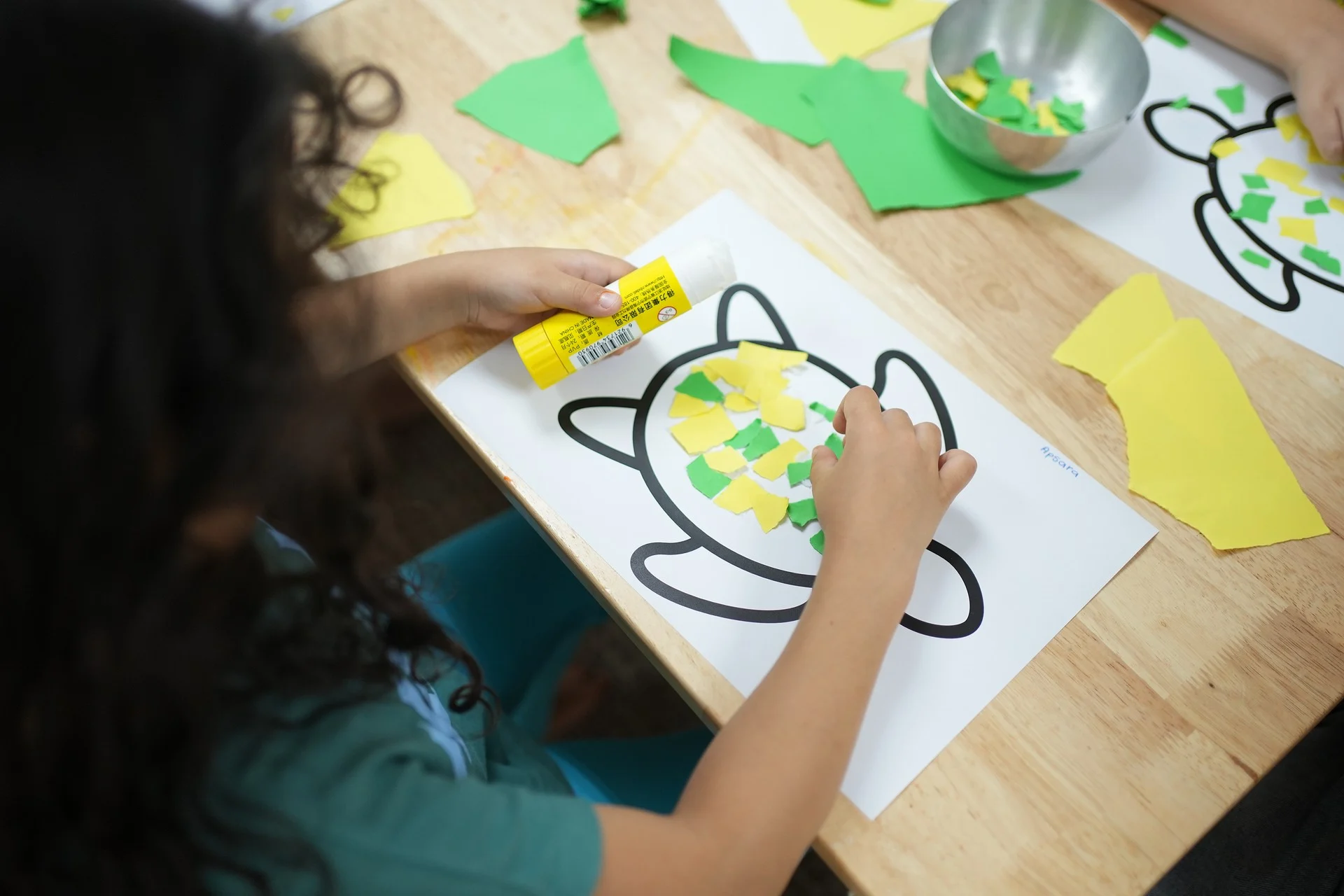
Paper collage activities in preschool offer practical opportunities to develop fine motor coordination, visual attention, creativity, and early classroom skills. Tearing, selecting, and gluing pieces of paper involves several small movements that children use in everyday tasks. At OrbRom Center in Phnom Penh, creative learning can be adapted to children’s developmental readiness so that each learner can participate with appropriate support.
Developing fine motor coordination
Collage making requires children to pick up materials, control finger movements, and place paper pieces in a chosen area. These actions involve hand-eye coordination, grasp, and controlled release. Holding the page steady while applying glue also encourages both hands to work together. Children who find smaller pieces difficult may begin with larger shapes. As their skills develop, educators can gradually introduce smaller materials and more precise placement. The focus is on functional movement and engagement rather than producing a perfect finished picture.
Practising bilateral coordination
Bilateral coordination means using both sides of the body together in an organized way. During a craft activity, one hand may hold a sheet of paper while the other tears or glues. Children can practise stabilizing materials, changing hand positions, and coordinating movements across the work area. These skills are also relevant to dressing, opening containers, and using classroom tools. Adults can demonstrate a movement and offer assistance while leaving opportunities for children to try independently.
Building attention and following instructions
A collage can be divided into a predictable sequence: choose paper, prepare glue, place the pieces, and finish the picture. Short instructions and visual examples can help children understand what comes next. Some children benefit from completing one step before receiving another direction. Others may be ready to plan their own design. Teachers can adjust the number of steps and the amount of prompting to match each child’s needs. Repeating a familiar routine may support confidence and independence.
Supporting early communication
Creative activities provide natural reasons for children to request materials, identify colours, ask for help, and share choices. Educators can model useful words such as more, finished, stick, and different while accepting gestures, pointing, or alternative communication. Children can also practise listening to peers and taking turns with shared supplies. The purpose is meaningful interaction within the activity, rather than testing vocabulary continuously.
Encouraging creativity and problem-solving
Open-ended craft tasks allow children to decide where materials belong and explore different arrangements. A child may experiment with overlapping pieces, selecting colours, or changing an initial plan. Educators can support problem-solving by offering manageable choices and allowing time for exploration. When a task becomes frustrating, simplifying the materials or modelling the next step can help preserve participation. Children should have opportunities to make decisions even when adult assistance is needed.
Adapting activities for different learning needs
Children differ in sensory preferences, attention, hand strength, and motor coordination. Some dislike sticky glue or the feel of torn paper. Glue sticks, larger paper shapes, pre-cut pieces, or alternative tools can reduce barriers. A child may also need a clear workspace or shorter activity periods. Adaptations should maintain the learning purpose while respecting comfort and choice. Progress is better judged through increasing participation and independence than by comparing finished artwork.
Preschool learning at OrbRom Center
OrbRom Center offers an early learning preschool program, occupational therapy, and individualized special education support in Phnom Penh. Families can discuss how structured play and creative activities may support their child’s learning, communication, and daily participation.
Leave A Comment