
Visual supports in special education can help children understand instructions, explore language, and make choices during learning activities. At OrbRom Learning Support Center in Phnom Penh, pictures are one of the practical tools used during personalised one-to-one intervention.
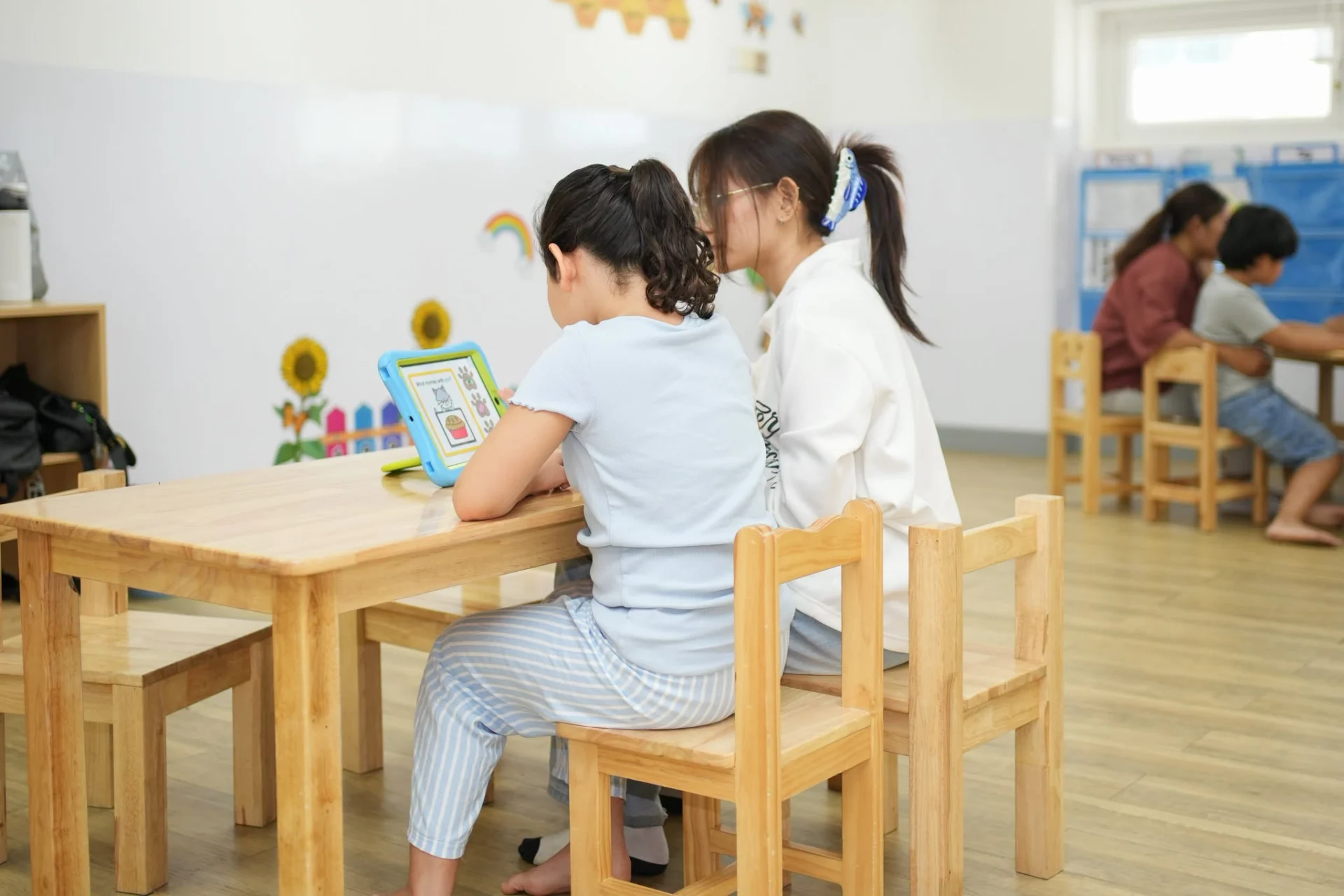
A classroom photograph shared by OrbRom shows an adult supporting a child at a table with a picture-based learning activity. The interaction illustrates how visual materials can be incorporated into direct teaching while the adult remains available to guide the child.
How visual supports make learning more accessible
Spoken instructions can be difficult to follow when a child needs additional processing time or benefits from concrete examples. A picture offers a visible reference that the child can look at again while listening, responding, or completing a task.
Visual supports may include pictures representing objects, actions, choices, or steps in a routine. The most useful format depends on what the child is learning and how they understand information. For some children, a picture can clarify a new word. For others, it can help them identify an activity or select between options.
Visual supports in one-to-one intervention
OrbRom’s approach is to choose teaching tools for a clear purpose, give children time to process information, and adjust the level of adult support. In a one-to-one session, a teacher or therapist can observe how a child responds and change the activity when needed.
For example, an adult might show two pictures, name the options, and allow the child time to indicate a choice. Another activity might pair a spoken instruction with an image that represents the requested action. These are examples of ways visual supports can be used; individual activities depend on each student’s learning goals.
Visual materials should support interaction rather than replace it. The adult still needs to check whether the child understands the task, respond to communication attempts, and offer guidance when required.
Supporting communication and independence
Pictures can give children another way to engage with learning. When a child can see the available choices or refer to a visual instruction, they may be better able to participate without relying on repeated verbal prompts.
Independence develops through appropriate opportunities to practise. This means giving enough support for the child to succeed while avoiding unnecessary prompting. As a child becomes familiar with an activity, the adult can review whether some assistance can be reduced.
At OrbRom, personalised intervention addresses communication, social skills, and academic readiness according to each child’s needs. Visual supports are one possible part of that work, alongside adult guidance and other teaching approaches.
Choosing the right approach for each child
No single visual tool works equally well for every learner. Teachers need to consider the child’s understanding, attention, communication abilities, and the particular task. A picture that is useful for one goal may need to be simplified or replaced for another.
Families can also ask how visual materials are being used and what skill each activity is intended to develop. Clear goals make it easier to understand why a teaching strategy has been selected and whether it is helping the child participate.
To learn about personalised learning support in Phnom Penh, explore OrbRom’s special needs intensive intervention program.
Visual supports in special education are most useful when they are chosen deliberately, combined with responsive teaching, and adapted to the individual child.

Leave A Comment