
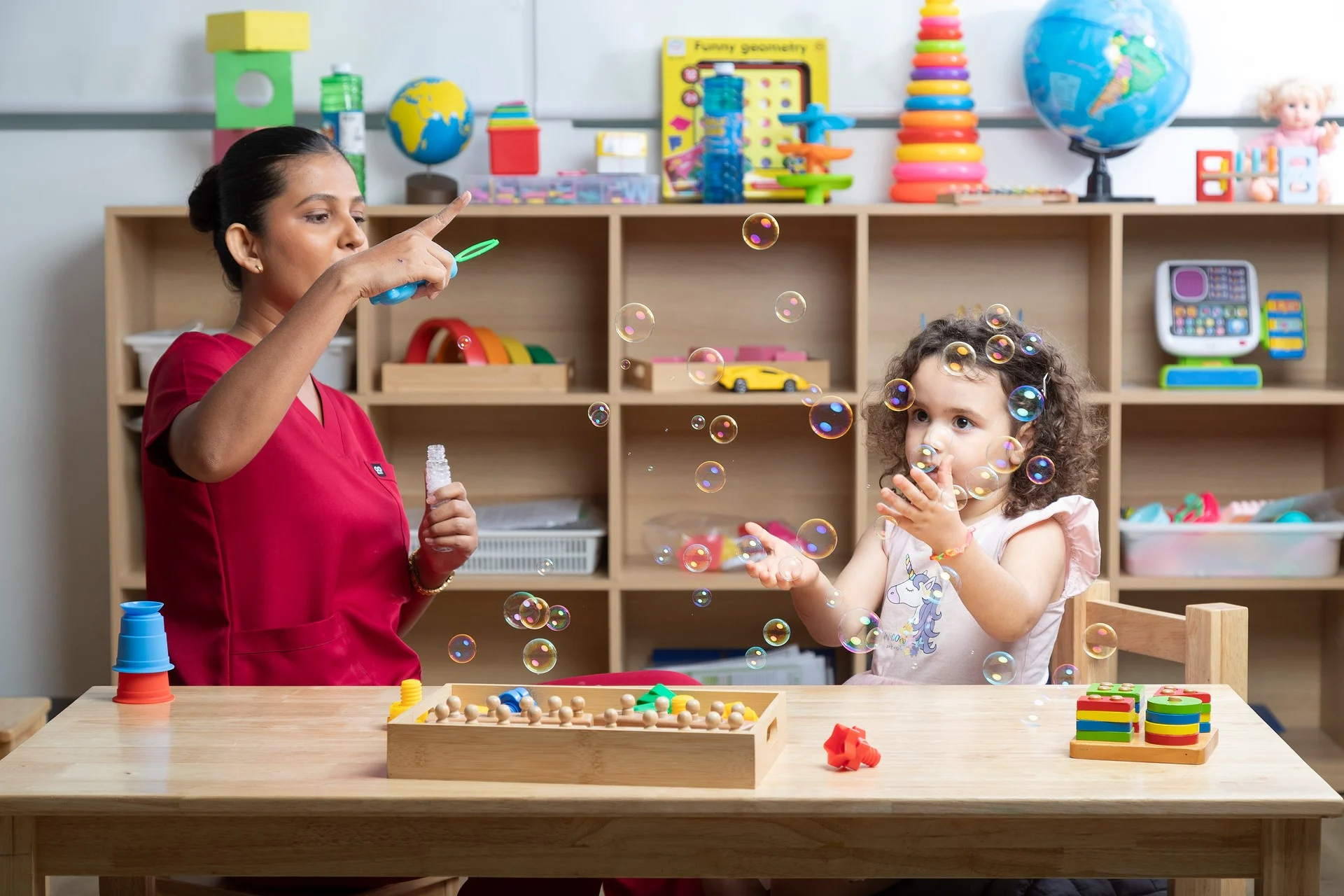
Play-based speech therapy creates opportunities for young children to develop communication while participating in activities they enjoy. Shared games can encourage requesting, commenting, turn-taking, and understanding language without requiring children to sit through repetitive drills. At OrbRom Center in Phnom Penh, speech-language goals can be incorporated into motivating activities and adapted to each child’s developmental needs.
Why play matters for communication
Children communicate for many reasons: to ask for something, share interest, protest, seek help, and connect with other people. Play provides natural situations for these purposes. A therapist may introduce a familiar toy, pause before continuing a game, or offer a choice so the child has a reason to communicate. Responses may include words, gestures, pointing, facial expressions, or augmentative communication. The therapist follows the child’s interests while creating purposeful opportunities to practise a target skill.
Developing joint attention
Joint attention involves sharing attention with another person toward an object or event. During an engaging activity, a child might look toward an object, point to it, or respond when an adult comments. Therapists can support this skill by following the child’s focus and making brief, meaningful comments. Eye contact should not be forced or treated as the only sign of engagement. The aim is shared communication and awareness of another person’s message.
Encouraging requests and expressive language
A child may learn to request ‘more,’ name an object, or combine words to describe what happens during play. Therapists can model language at an appropriate level and give the child enough time to respond. For children who do not yet use spoken words consistently, gestures, pictures, or communication devices may provide an effective way to participate. The goal is functional communication rather than insisting on one particular response format.
Supporting receptive language and attention
Play activities can also support understanding instructions, action words, and early concepts. A therapist might use phrases such as ‘ready, set, go,’ ‘stop,’ ‘up,’ or ‘again’ within a predictable game. Short instructions paired with actions or visual cues may help children understand what is expected. The level of difficulty should change gradually as the child becomes more confident. Attention can be supported by choosing motivating materials and adjusting the length of an activity.
Turn-taking and social interaction
Simple games offer opportunities to practise waiting, responding, and taking turns. Adults can model language such as ‘my turn’ and ‘your turn’ while making the exchange enjoyable and predictable. Children who find waiting difficult may need very short turns, visual cues, or additional support. Successful participation can include communicating a preference or signalling when they are finished. Social communication goals should respect each child’s individual communication style.
Adapting therapy to each child
Speech-language therapy should reflect the child’s communication profile, sensory preferences, hearing needs, and family priorities. Some children engage best through movement, while others prefer books, construction toys, or quiet tabletop games. Therapists can adjust the materials and demands without losing sight of the learning objective. Progress should be monitored across sessions and everyday settings, rather than inferred from one enjoyable activity. Families can reinforce selected goals during familiar routines at home.
Speech therapy at OrbRom Center
OrbRom Center provides speech therapy for children, individualized special education intervention, and an early learning preschool program in Phnom Penh. Families can contact the center to discuss communication concerns, assessment options, and appropriate support for their child’s development.
Leave A Comment