
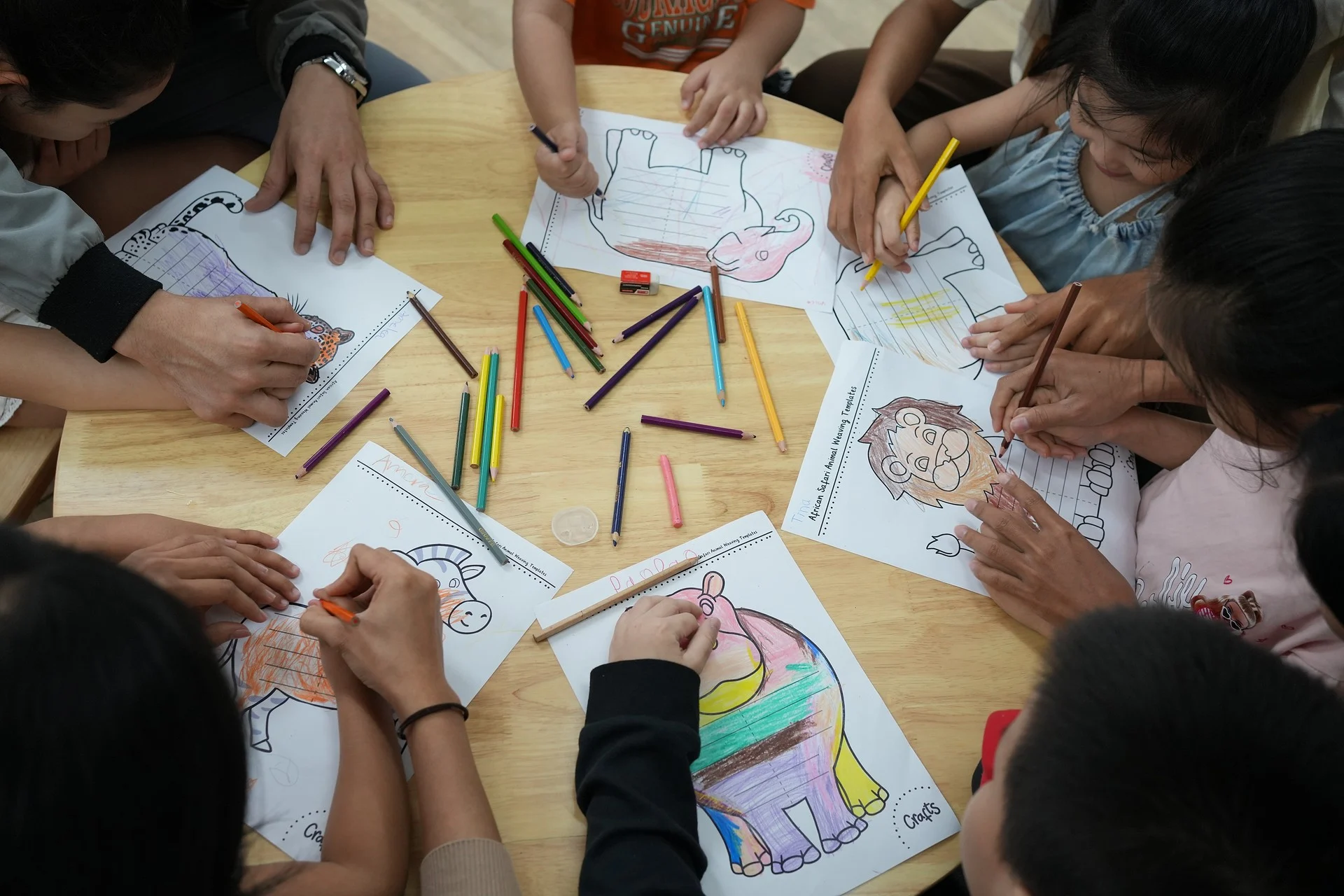
Group art activities in preschool create opportunities for children to develop fine motor control, communication, early learning skills, and social participation. Colouring and drawing are familiar activities that educators can adapt for children with different developmental abilities. At OrbRom Center in Phnom Penh, creative tasks can form part of individualized learning experiences that encourage children to explore materials, practise new skills, and participate alongside peers.
Fine motor development through colouring
Holding a coloured pencil, adjusting grip, and moving it across paper require coordination between the fingers, hand, wrist, and arm. Children may practise controlled movements while filling an area, drawing lines, or making their own marks. These actions can support skills used in writing, manipulating classroom materials, and everyday tasks. Educators should consider comfort and function rather than insisting on a single pencil grip. Larger pencils, shorter activities, or different drawing surfaces may help children participate.
Building attention and following instructions
Art tasks provide opportunities to follow short directions and complete manageable sequences. A child might choose a colour, locate a section of a picture, and begin colouring. Educators can demonstrate one step at a time, provide visual examples, and allow processing time. Some children benefit from a clear starting point and an indication of when the activity will finish. Others may be ready to follow two-step instructions or make more independent choices. The level of support should reflect the child’s understanding.
Language and communication during art
Shared creative activities give children natural reasons to communicate. They may request a pencil, identify a colour, ask for help, or comment on their work. Adults can model simple language such as ‘more blue,’ ‘your turn,’ or ‘I finished’ without making every interaction a test. Children who use gestures, picture-based communication, or other communication systems should have equal opportunities to make choices and participate. Meaningful communication matters more than producing a particular spoken response.
Learning alongside other children
Group art activities can encourage children to notice peers, share materials, wait briefly, and respect personal space. Educators can create opportunities for cooperation without requiring every child to interact in the same way. Some children enjoy working together, while others participate more comfortably when given individual space at a shared table. Structured turn-taking and clear expectations can help children understand how to join the activity.
Supporting creativity and independence
Children benefit from opportunities to select colours, experiment, and make decisions about their work. A completed picture does not need to look identical to an adult’s example. Educators can acknowledge effort, persistence, and independent choices while avoiding unnecessary correction. A child may practise staying with a task, asking for a break, or returning after a short pause. These are useful participation skills even when the final artwork remains unfinished.
Adapting activities for different needs
Children vary in hand strength, coordination, sensory preferences, and attention. Some may need a thicker pencil or paper secured to the table. Others may prefer shorter sessions, fewer materials, or a quieter workspace. Adults can offer assistance while gradually encouraging independence. Observations should focus on what the child can do, what support is helpful, and whether the skills carry over into everyday learning activities.
Preschool and developmental support at OrbRom Center
OrbRom Center offers an early learning preschool program, occupational therapy, and individualized special education intervention in Phnom Penh. Families can discuss fine motor development, classroom participation, and communication goals to identify appropriate support for their child.
Leave A Comment