
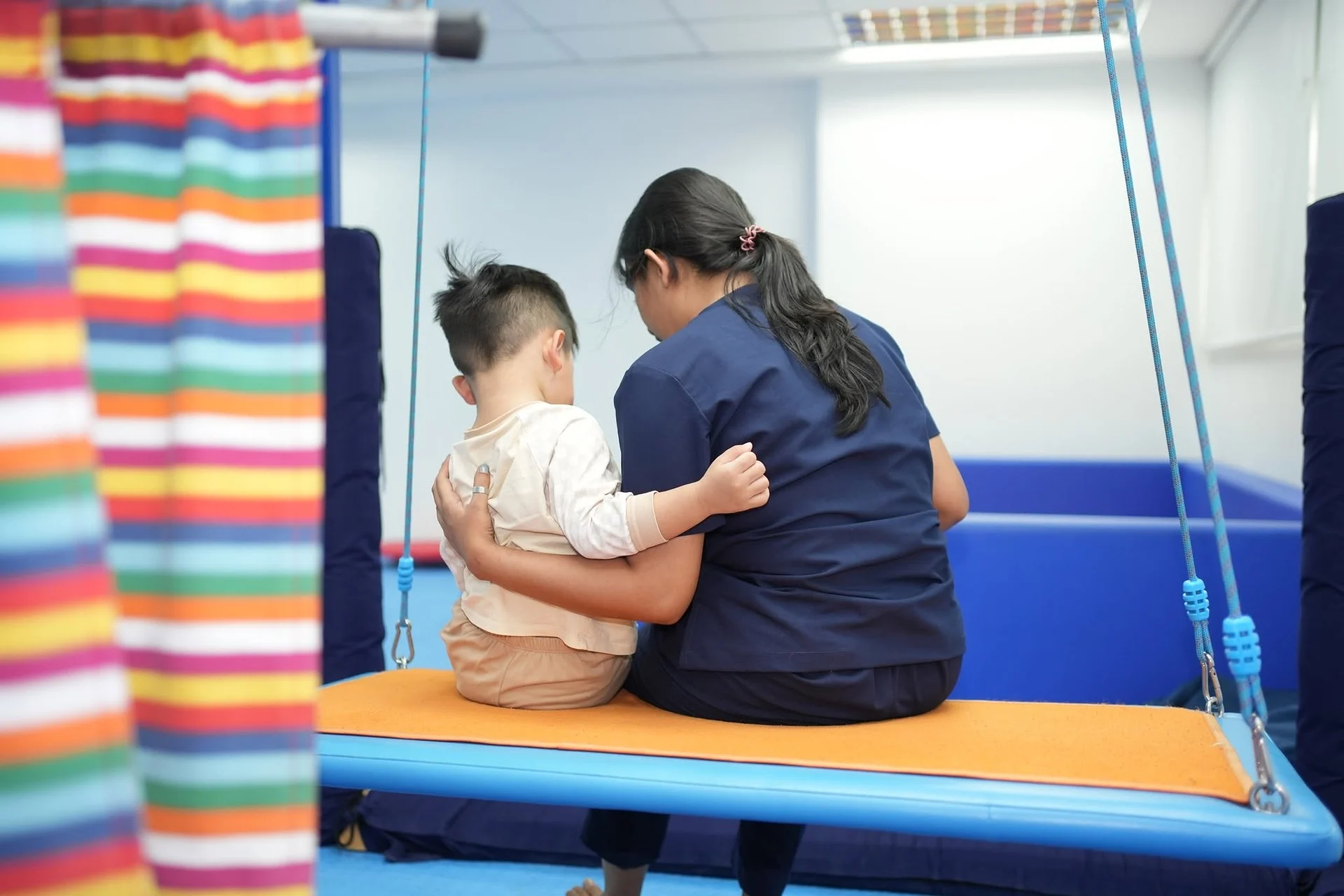
Therapeutic swings in occupational therapy provide structured movement experiences that can help children develop balance, postural control, body awareness, and coordination. Swing-based activities are commonly used in pediatric occupational therapy, particularly for children who experience sensory processing difficulties or challenges with motor development.
For some children with autism, ADHD, or developmental delays, movement-based activities can also support sensory regulation and participation in everyday tasks. However, responses to swinging vary, and activities must be adapted to each child’s abilities and sensory preferences.
At OrbRom Center in Phnom Penh, our occupational therapists incorporate sensory and movement-based activities into individualized intervention programs when they support a child’s functional goals.
How therapeutic swings support sensory processing
Swinging stimulates the vestibular system, which is located in the inner ear and helps the brain detect movement, head position, and changes in balance.
The vestibular system works closely with visual and proprioceptive systems to support posture, coordination, and spatial orientation.
Different types of movement provide different sensory experiences. Gentle forward-and-backward swinging may be comfortable for some children, while rotational or unpredictable movement can be overwhelming.
Children with sensory processing difficulties may be unusually sensitive to movement or actively seek additional movement experiences.
Occupational therapists assess these responses before selecting appropriate activities.
Developing balance and postural control through swinging
Maintaining an upright position on a swing requires children to activate muscles in their trunk and adjust their posture as the surface moves.
With appropriate positioning and support, swing-based activities can provide opportunities to practice:
- Postural stability: Maintaining body alignment during movement.
- Core muscle activation: Engaging trunk muscles to support sitting and balance.
- Body awareness: Recognizing body position during changes in movement.
- Motor coordination: Adjusting movements to maintain stability.
- Balance reactions: Responding to controlled changes in position.
These abilities contribute to functional activities such as sitting at a desk, moving around the classroom, and participating in playground activities.
Learn more about gross motor development in children and how movement experiences support physical development.
Can swinging help children with sensory regulation?
Some children find gentle, predictable swinging calming, while others experience increased alertness or discomfort.
An occupational therapist considers the child’s sensory profile, physical abilities, and behavioral responses when determining whether swinging is appropriate.
For example, a child who seeks movement throughout the day may benefit from planned movement opportunities. Another child who becomes anxious when their feet leave the ground may require gradual exposure or alternative activities.
The objective is to support participation in meaningful daily activities rather than provide movement without a specific therapeutic purpose.
Parents can explore additional proprioceptive activities that may complement individualized sensory regulation strategies.
Why therapist supervision is important
Therapeutic swinging requires appropriate equipment, positioning, and professional supervision.
Occupational therapists monitor movement speed, direction, duration, postural stability, and signs of discomfort.
Children should never be forced to participate. Activities must also account for medical conditions, movement sensitivities, and individual safety requirements.
The effectiveness of sensory-based interventions varies, and research does not establish that swinging alone consistently improves attention, emotional regulation, or behavior.
A broader sensory integration approach may be considered when assessment findings indicate specific sensory-motor difficulties.
Occupational therapy for sensory and motor development in Phnom Penh
At OrbRom Center, our occupational therapy services support children experiencing difficulties with sensory processing, balance, coordination, motor planning, and everyday independence.
Our occupational therapists use individualized activities, including therapeutic swings when appropriate, to address specific developmental and functional goals.
Children may work on maintaining posture, tolerating movement, coordinating their bodies, or participating more comfortably in daily routines.
For families seeking occupational therapy in Phnom Penh, OrbRom Center provides individualized assessments and intervention programs designed around each child’s developmental needs.
Therapeutic swings can be one component of this support, with activities selected according to assessment findings, safety considerations, and measurable functional goals.
We are the only Preschool specialized on children with special needs in PhnomPenh.
| Included therapy sessions per month: |
| – Speech Therapy – 4 sessions / month |
| – Occupational Therapy – 4 sessions / month |
| – Free pre-enrollment assessment |
| – Individualized Learning Plans (ILPs) |
📞 Phone: 077.455.993
Telegram Link: https://t.me/OrbRom

Leave A Comment