
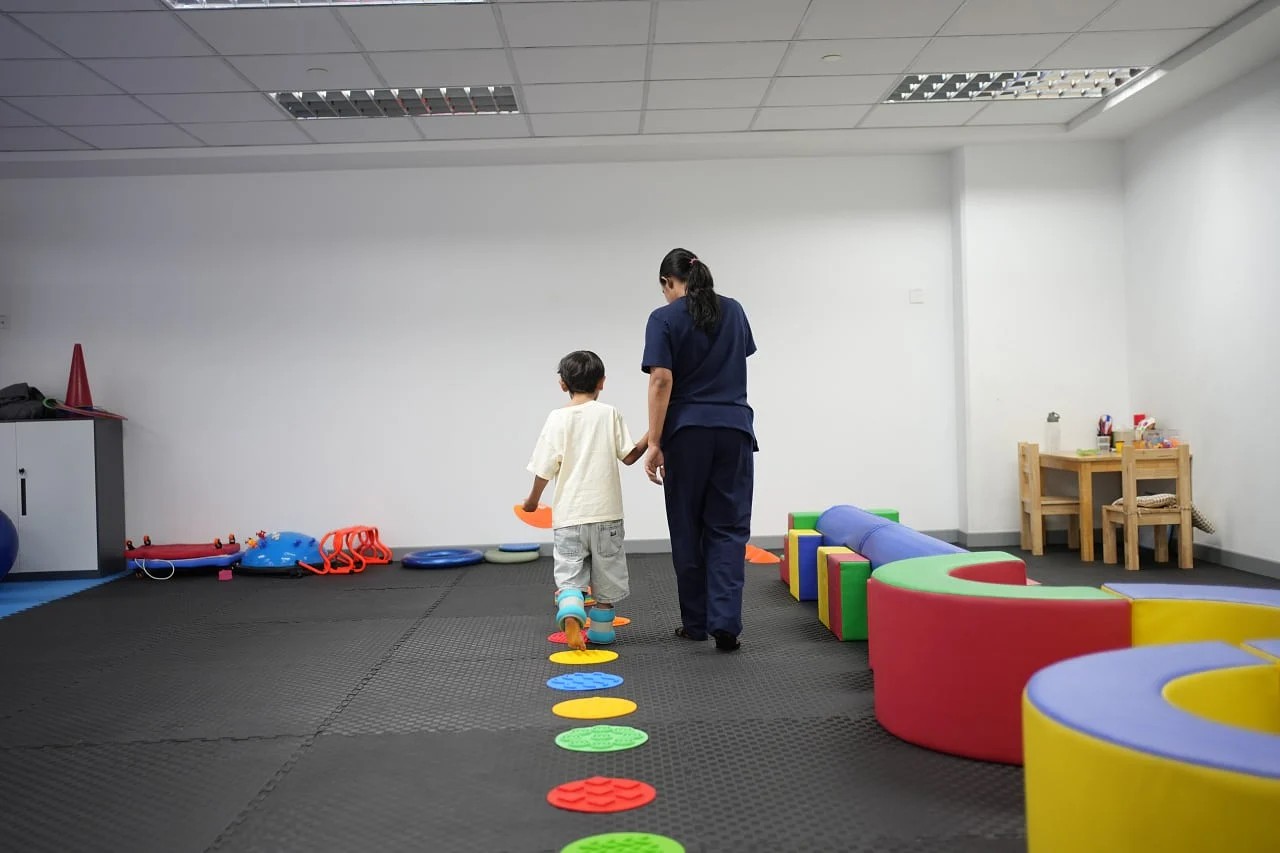
Occupational therapy for children in Phnom Penh can include movement activities that help children practise balance, coordination and body awareness. At OrbRom Learning Support Center, a photograph shows a child stepping along colorful floor markers while an adult walks beside them in a room equipped with soft-play materials.
This kind of guided movement activity provides opportunities to practise stepping, adjusting body position and moving from one target to the next. The photograph captures one moment; it does not establish the child’s diagnosis, treatment goals or progress.
How stepping activities can support balance
Balance helps children stay upright while standing, walking and changing direction. A pathway of floor markers gives a visible sequence to follow. Children may need to shift their weight, place each foot carefully and adjust their posture as they move.
An adult can adapt the task by changing the distance between markers, offering physical support when appropriate or reducing the number of steps. The aim is to match the activity to the child’s current abilities and the skill being practised.
Building coordination and motor planning
Coordination involves organizing movements so that different parts of the body work together. Motor planning is the process of deciding how to carry out a movement and putting that plan into action. Both can be practised through structured activities that ask children to follow a path, step over an obstacle or change direction.
Colorful markers can provide a simple visual guide. A child might be asked to move to the next circle, pause or follow a short sequence. These are examples of possible activities rather than a description of the precise instructions used in the pictured session.
Body awareness and sensory-motor learning
Body awareness helps a child understand where their body is in space. Movement activities provide information through the muscles and joints, while the eyes and balance system help the child navigate the environment.
For some children, structured sensory-motor activities may be useful when learning to control movement or participate in everyday tasks. An occupational therapist considers the child’s individual needs before choosing the activity, the amount of support and the level of challenge.
Why adult guidance matters
In the photograph, an adult stays close to the child during the stepping activity. Close supervision is important when children practise movement skills, especially when balance or coordination is challenging.
Guidance may involve demonstrating the next movement, giving a short instruction, allowing time to respond or providing physical assistance when needed. The type of support should reflect the child’s safety and learning needs. As a task becomes more familiar, the therapist can review whether less prompting is appropriate.
Connecting movement skills to daily activities
Balance, coordination and motor planning are relevant beyond a therapy room. Children use these skills when walking across uneven surfaces, climbing stairs, navigating playground equipment and taking part in physical games.
Practising a movement in a structured setting does not automatically mean it will transfer to every daily activity. Therapists can help families identify useful opportunities to practise skills in familiar routines and monitor whether the child is becoming more confident and independent.
Occupational therapy at OrbRom Center
OrbRom Learning Support Center provides pediatric occupational therapy and other developmental support services in Phnom Penh. Activities are selected according to each child’s needs rather than following a single exercise program for every learner.
Families interested in occupational therapy for children in Phnom Penh can learn more about OrbRom’s services and discuss whether an assessment is appropriate for their child.
Guided stepping activities are one practical example of how occupational therapy can incorporate movement, visual cues and individual support to help children practise foundational motor skills.
Leave A Comment