
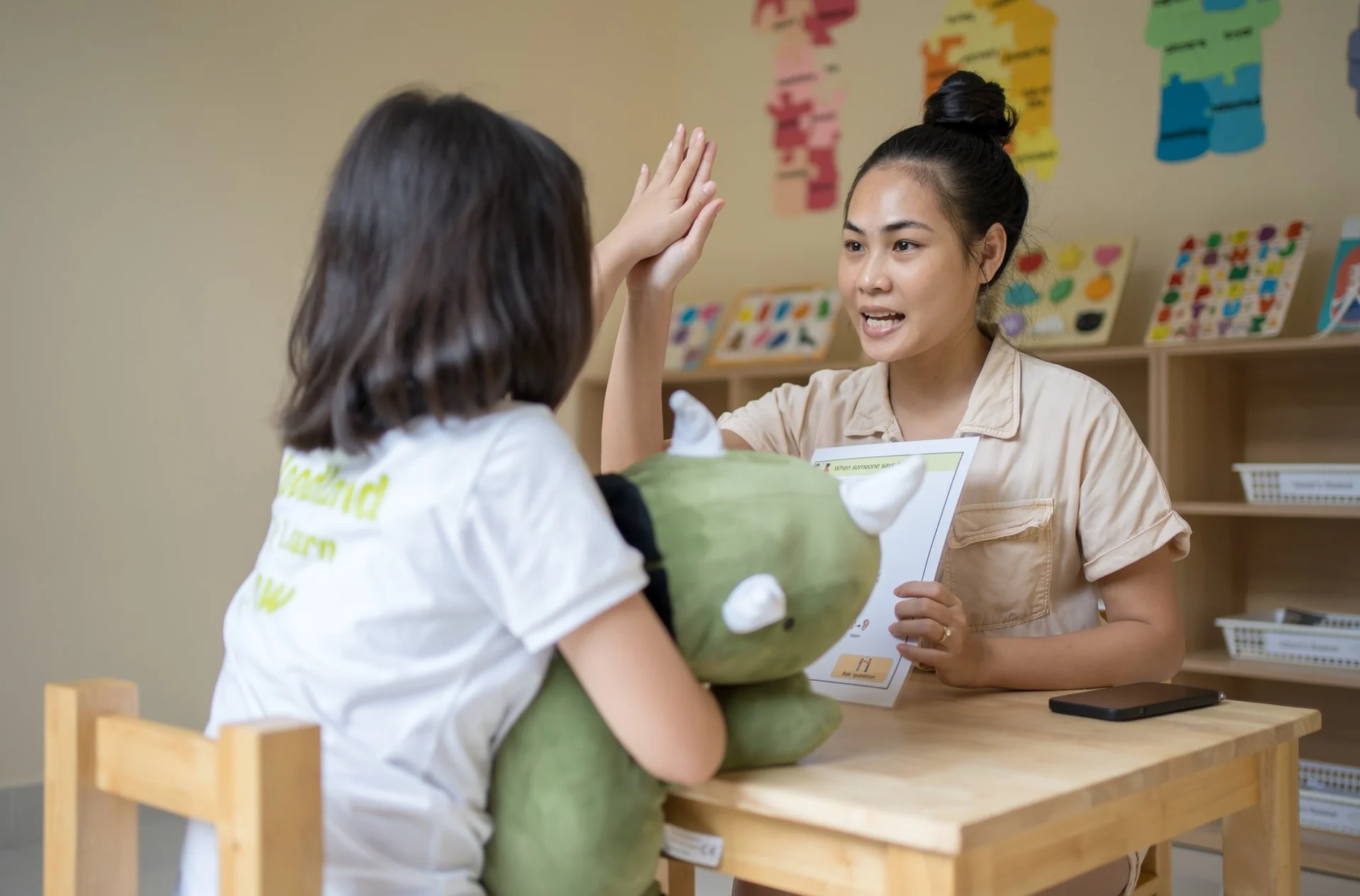
Positive reinforcement can help children develop communication, participation, and independence when it is used thoughtfully in special education. A meaningful response from an adult—such as specific praise, acknowledgement, or access to a preferred activity—can encourage a child to practise a useful skill again. At OrbRom Center in Phnom Penh, reinforcement strategies should be individualized, respectful, and connected to practical learning goals.
What positive reinforcement means
Positive reinforcement occurs when something is added after a behaviour and that behaviour becomes more likely to happen again. A smile or verbal praise may be reinforcing for one child but not for another. The effect depends on the child’s preferences and whether the behaviour actually increases over time. Educators should therefore observe individual responses rather than assume that every reward or compliment works equally well.
Supporting communication through natural interactions
Communication provides many opportunities for meaningful reinforcement. When a child requests help, an adult can respond promptly by providing assistance. When a child communicates a choice, the adult can acknowledge that choice and, where possible, honour it. These natural consequences show children that communication has a useful purpose. Spoken words, gestures, pictures, and augmentative communication can all be recognized as valid ways to express needs.
Using specific praise and feedback
Feedback is most informative when it identifies what the child did. Instead of repeatedly saying ‘good job,’ an educator might say ‘You asked for help’ or ‘You waited for your turn.’ Specific language can clarify which action is being acknowledged. Some children enjoy enthusiastic praise, while others prefer quiet acknowledgement. The tone and frequency of feedback should match the child’s comfort and understanding.
Building confidence without pressure
Learning activities should allow children to make choices, attempt difficult tasks, and request breaks. Reinforcement is not a reason to withhold basic needs, ignore distress, or demand uncomfortable physical contact. A high-five, for example, should always be optional. Educators can offer alternatives such as a wave, thumbs-up, verbal acknowledgement, or a preferred activity. Respecting a child’s preferences supports trust and meaningful participation.
Teaching skills in manageable steps
Complex skills can be broken into smaller steps so children have achievable opportunities to practise. A child learning to follow a classroom routine might begin by putting away one item with a visual prompt. As the child becomes more independent, adults can adjust the assistance and reinforce progress toward the broader goal. The level of prompting matters: completing a task with extensive support is different from doing it independently.
Monitoring progress and generalization
A strategy is useful when it produces meaningful changes that can be observed over time. Teachers and therapists can record how often a skill occurs, what support was needed, and whether the child uses it in different environments. Families may notice that a child requests help more readily at home or participates more comfortably in everyday routines. These observations help the team decide whether to continue, adapt, or replace a strategy. For example, a strategy that works during an individual session may need adjustment in a busy classroom. Staff can collaborate with families to identify useful rewards, avoid unnecessary pressure, and encourage children to apply their skills during ordinary activities.
Individualized learning support at OrbRom Center
OrbRom Center provides individualized special education intervention, speech therapy, and an early learning preschool program in Phnom Penh. Families can discuss communication, behaviour, and participation goals with the team to identify suitable assessment and support options.
Leave A Comment